Trail & ultra
Trail and ultra training plans, built on time and climbing.
Pick your race, from a short trail to 200 km and beyond, with its elevation gain. RunWay plans your weeks in hours, not kilometers, and your coach calls out time, climbing and fuel while you run.

Free on the App Store · iPhone
From a 5 km trail to 200 km and beyond.
Tell RunWay about your race: its distance, its elevation gain, its date and, if you want one, a target time. The plan sizes your preparation with effort-km, the trail runner’s yardstick: distance plus one kilometer for every 100 meters of climbing.
- Any race size. A 15 km trail with 500 m of climbing, a mountain marathon, a 100 km ultra or a 100-mile race.
- A prep that fits. Its length depends on the race and on your current fitness, as the table shows.
- A taper that matches. One easier week before most races, two before long ultras.
New to effort-km and vertical? Our guide to trail vs road training explains what changes.
| Effort-km | Example | Plan |
|---|---|---|
| Under 25 | 15 km, 500 m up | 8–12 weeks |
| 25 to 50 | 30 km, 1,500 m up | 10–16 weeks |
| 50 to 90 | 50 km, 2,500 m up | 12–20 weeks |
| 90 to 170 | 100 km, 5,000 m up | 16–24 weeks |
| 170 and more | 160 km, 10,000 m up | 18–24 weeks |
Counted in hours, steered by effort.
On a 15 % climb, pace means nothing. So your trail plan measures volume in hours and sets targets in heart-rate zones or perceived effort, never in minutes per kilometer.
- Ultras planned in time. From 42 km, or with big elevation, long runs read like “long run 3 h 30”, and your weekly volume is in hours.
- Long runs with vertical. Climbing is built into your long runs, in proportion to your race.
- Back-to-backs for ultras. A single long run never goes past 5 h 30. The rest comes from long runs on consecutive weekend days.
- Readiness still counts. Sleep, HRV and resting heart rate from Apple Health can lighten the day, as in road plans.
- 5–200+kilometers, from a short trail to beyond 100 miles
- +1 kmof effort for every 100 m of climbing
- 5 h 30longest single long run; back-to-backs do the rest
- 0pace targets: heart-rate zones or effort instead
A coach that speaks trail.
On time-based sessions, kilometer splits make way for time checkpoints: every 15 or 30 minutes on shorter outings, every hour on long ones. Each call gives your running time, what’s left, the climbing done against the climbing planned and, on runs of 1 h 30 or more, a nudge to eat on the hour.
Your briefing, your debrief and the chat all know which race you’re preparing, so the advice fits the mountain, not the track.
Your race course, in your ears.
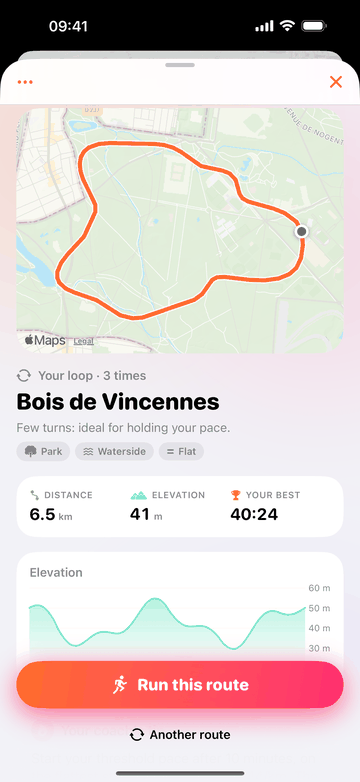
Import your race’s GPX file and RunWay guides you along it by voice, turn by turn. Going the other way, export your routes as GPX to load them on your Garmin, COROS or Suunto watch.
See how routes and GPX work in RunWay.
Sessions made for the mountains.
Your weeks mix easy time on your feet with sessions that train what trail races ask for.
Hills and climbs
Short hill repeats and long sustained climbs, by effort.
Power hiking
Walking the steep parts, on purpose. It’s a skill, so it’s trained.
Downhills
Descent sessions, so your legs learn to handle the way down.
Hilly threshold
Sustained, comfortably hard running on rolling terrain.
Back-to-backs
Long runs on consecutive days for ultras, to train tired legs.
Taper
Volume eases off before race day: two weeks for long ultras.
FAQ
Can I train for a 100-mile or 200 km race?
Yes. Trail plans go from 5 to over 200 km, with the elevation gain of your race. Above about 170 effort-km, the preparation lasts 18 to 24 weeks, long runs top out at 5 h 30 and back-to-back weekend runs add the rest.
Why does the plan use time instead of distance?
Because 10 km on a mountain path and 10 km on the road are not the same effort. Hours and heart-rate zones or perceived effort describe the work much better, so ultras (42 km and more, or big elevation) are planned in hours.
Do I have to set a target time?
No, it’s optional. Give the race distance, its elevation gain and its date; add a target time only if you have one in mind.
Does the coach work on trails with no signal?
Yes. GPS doesn’t need a data connection, and with no signal your coach keeps talking with built-in phrases and the iPhone voice. When you’re online, the AI writes the lines and a natural voice speaks them.
Can I send my route to my watch?
Yes. Export any route as a GPX file (track, laps, altitude and turn cues as waypoints) and load it on your Garmin, COROS, Suunto or other GPX-compatible watch.

Your running coach, in your ears.
Download RunWay, put your earbuds in, and go.
Free on the App Store · iPhone · iOS 18 or later